
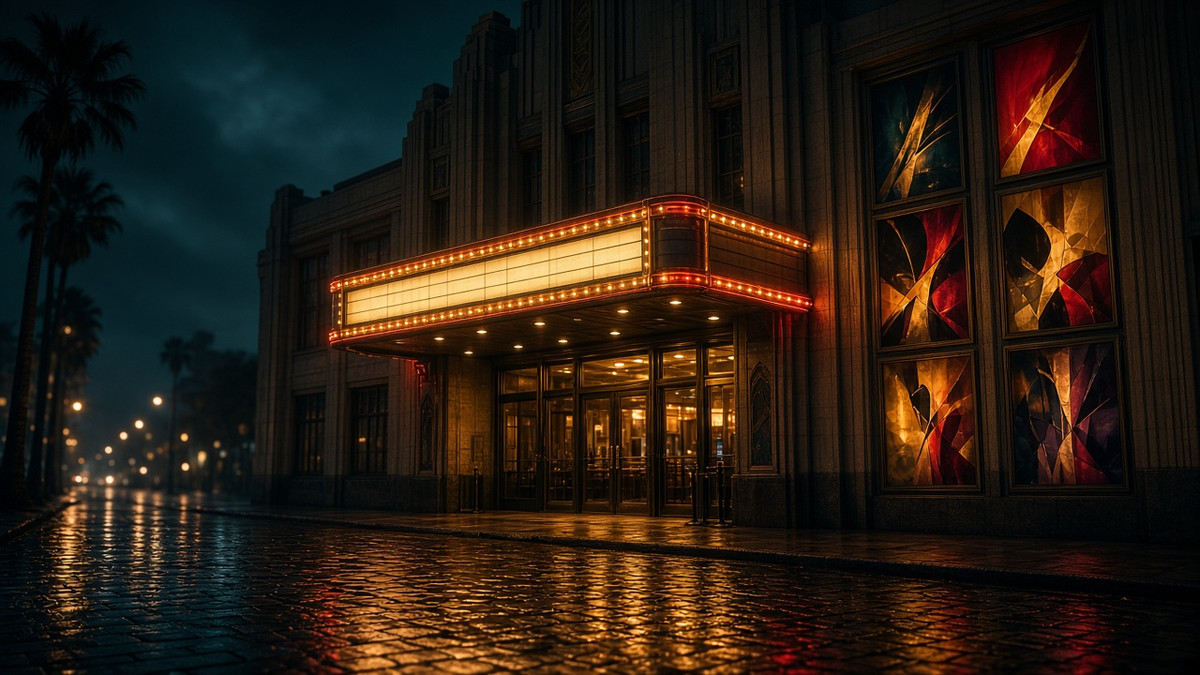
Desire still sells in the cinema and on the home screen. The industry has not retired attraction as a marketing tool. It has professionalised the sale, from the casting shortlist and the trailer cut to the poster crop and the thumbnail that only your account ever sees.
Walk through a booking meeting and the polite words arrive first: presence, chemistry, heat, awareness. The question underneath has not changed. Will this person, in this frame, make a stranger stop and stay? Hollywood learned new manners around how those frames are shot. It did not unlearn how those frames are sold.
Desire still sells before a camera rolls
Casting is the first commercial decision, not an afterthought. A lead is hired for craft, for an audience they already own, and, more often than press notes admit, for the way the camera holds them. Chemistry tests exist because a poster has to promise a charge between two people who may have met that week. None of that requires gossip. It requires an honest look at the marketing packet that goes out with the green light: a face, a silhouette, a promised tension.
The current studio example on this site is already in motion. The Thomas Crown Affair trailer has a 5 March 2027 date attached to Michael B. Jordan’s reimagining, a film being sold, as the original was, on style, pursuit and a charged lead pairing. The trailer is the pitch. The date is the ask.
Trailers, key art and the crop that does the talking
Once the film exists, the sell moves to three surfaces: the teaser, the one-sheet and the locked stills. Editors will open a trailer on a glance, a held stare, a dance, then cut away before the plot has to explain itself. Poster designers crop for the same reason. Billing blocks are legal. The image is the hook.
Streamers inherited that logic and made it more aggressive, because a title has only a second or two to win a scroll. The danger is obvious, and this newsroom has already flagged it in another context: a loud image can outrun the actual room, as in our report on empty-hall bookings behind nine-figure posters. Attraction in the art is not the same thing as demand in the seats. It is still how most titles get a first click.
The Netflix thumbnail is not the same for everyone
Netflix has been explicit about this. In a 7 December 2017 post on the Netflix Technology Blog, “Artwork Personalization at Netflix,” engineers Ashok Chandrashekar, Fernando Amat, Justin Basilico and Tony Jebara described a system that chooses, for each member, which image should represent a title. The company had already used bandit tests to hunt for a single best piece of art. The newer work asked a sharper question: would a title earn more plays if each account saw the image most likely to pull that account in?
Their own example was Good Will Hunting. A member with a history of romantic titles might be shown artwork of Matt Damon and Minnie Driver. A member who had been watching comedies might be shown artwork of Robin Williams. Different images for Stranger Things, the authors wrote, each took more than 5 percent of impressions, covering a breadth of themes that no single still could hold. They said the approach produced a meaningful lift in discovery and that they had rolled it out to everyone. It was, in their phrasing, the first time Netflix personalised not only what it recommended but how it recommended it. Later technical posts have kept refining that machinery, including work on impressions. The 2017 paper is still the plainest official account: the thumbnail is a private sales pitch.
The recent grosses that tested the appetite
Theatrical numbers still punch holes in the idea that adult attraction is only a streaming niche. Columbia Pictures’ Anyone But You, the Sydney Sweeney and Glen Powell rom-com that opened in December 2023, finished at $220.3 million worldwide, according to Box Office Mojo, including $88.3 million domestic and $132.0 million international. It opened to a soft $6.0 million. Variety, on 25 February 2024, reported that the film had crossed $200 million, called it the first romantic comedy in half a decade to do so since Crazy Rich Asians, and put the production cost at $25 million. A modestly budgeted date movie, held in theatres by word of mouth and social clips, still printed a serious multiple.
A24’s Babygirl, directed by Halina Reijn and led by Nicole Kidman, is the colder test: an adult workplace thriller sold on power and transgression, not on a holiday kiss. Box Office Mojo puts the worldwide gross at $64.7 million, with $28.2 million in North America and $36.5 million overseas, after a $4.5 million start on 25 December 2024. That is not a blockbuster. It is a specialised run that found a paying audience for a film that never pretended to be four-quadrant.
Luca Guadagnino’s Challengers, released by Amazon MGM Studios and led by Zendaya, landed between those poles. Box Office Mojo records $96.1 million worldwide, $50.1 million of it domestic, after a $15.0 million opening in April 2024. The tennis triangle was marketed as sweat, rivalry and a charged look across a court. The trailer and the key art did a lot of the work before a single review landed. These three titles are not a ranking, and they are not a claim that every sensual film mints money. They are the recent, countable cases.
The intimacy coordinator era: the sale continues on the performers’ terms
The other half of the shift is on set, not in the media deck. Under the 2023 SAG-AFTRA television and theatrical agreement, as summarised in union materials and reported by Rolling Stone and Variety, producers must use best efforts to engage an intimacy coordinator for scenes involving nudity or simulated sex. They must also consider, in good faith, a performer’s request for a coordinator on other scenes, and they may not retaliate for that request. That is not a blanket legal command that every production, in every territory, must hire one. It is a contract standard that moved a once informal safeguard into the paperwork.
The commercial point is easy to miss if you only argue about process. Studios still want the charged scene in the trailer. Performers now have a stronger basis to control how that scene is planned, covered and cut. Attraction remains a marketing tool. It is just harder, and rightly so, to shoot it as a surprise. For the talent-price version of the same market, see Celebrity Fees on sex appeal fees. Fame and public couplings still do promotional work, as Global Celebrity Meter maps in 10 controversial Hollywood relationships.
The honest close is not a moral. It is a sales report. If a film or a series needs a stranger to lean in, the campaign will still lead with attraction. The difference now is that the thumbnail may be aimed at you alone, and the scene behind it is supposed to have been negotiated in advance.
FAQ
Does Netflix really show different artwork to different viewers?
Yes. Netflix’s own technology blog, in December 2017, described artwork personalization that selects, for each member, which image represents a title, and said the system had been rolled out to everyone.
Which recent films show that desire still sells at the box office?
Box Office Mojo puts Anyone But You at $220.3 million worldwide, Challengers at $96.1 million and Babygirl at $64.7 million. Variety also reported Anyone But You as the first rom-com in five years to cross $200 million, with a $25 million production cost.
Are intimacy coordinators mandatory on every Hollywood film?
Not as a blanket rule. The 2023 SAG-AFTRA agreement requires best efforts to engage one for scenes involving nudity or simulated sex, and good-faith consideration of a performer’s request, with no retaliation. Coverage in Variety and Rolling Stone treated that as a contract standard, not a statute covering every set worldwide.
How do trailers and posters still sell attraction?
By leading on a glance, a pairing and a crop, often before the plot is explained. The same logic now sits inside streaming thumbnails, which can be tailored to a single account.


2 thoughts on “Desire Still Sells: How Hollywood and Streaming Market Attraction”